There will be an election on Saturday, October 17, 2026.
At that time, eligible voters for the District of Logan Lake will elect:
- One (1) Mayor;
- Six (6) Councillors; and
The Mayor and Councillors will serve a four-year term from 2026 to 2030.
General local elections are the most direct way for the public to influence their local government by determining the individuals who then make decisions and govern on their behalf following general voting day.
Visit the Elections BC website for important information about campaign contributions, advertising rules, key dates and more at elections.bc.ca.
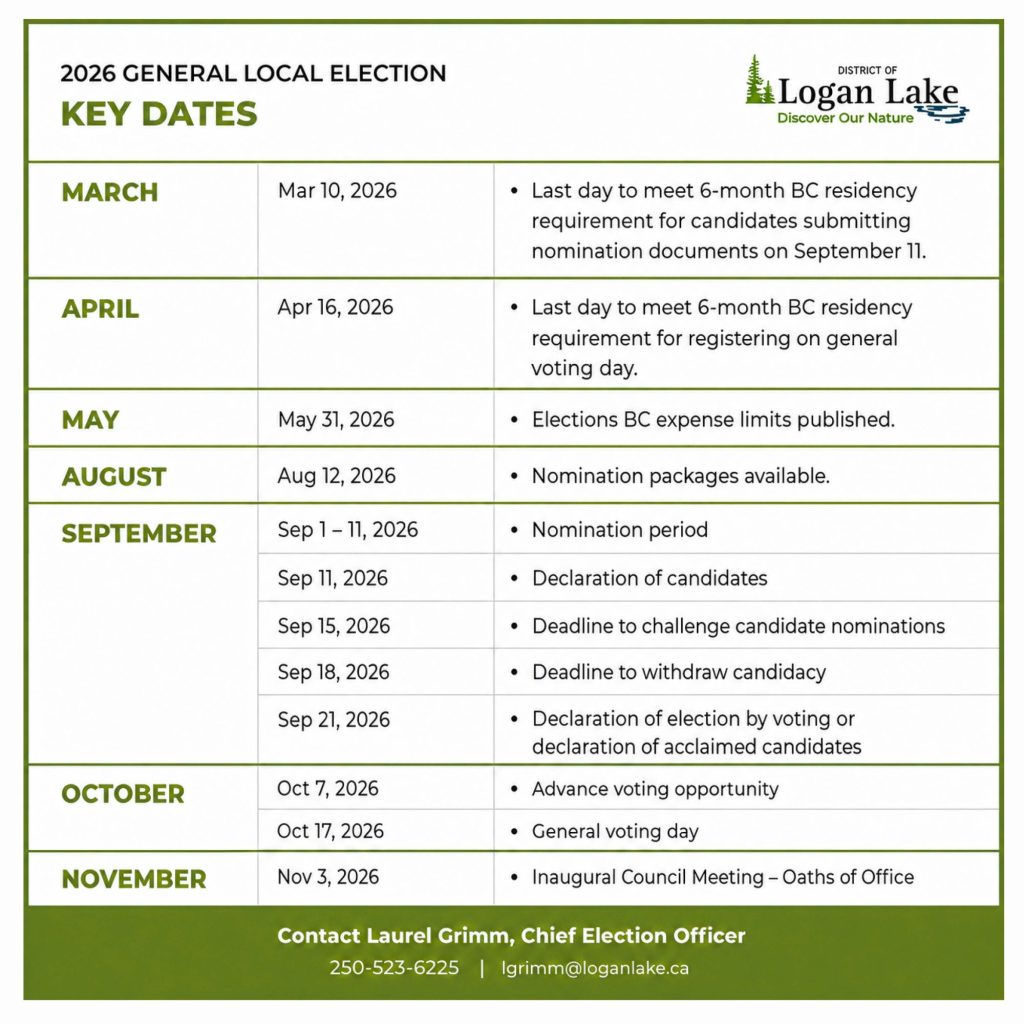
Information for Candidates
Thinking of Running for Local Office?
Learn about the role you will play and the impact you will have on your community as an elected official.
Nomination Packages are available on August 12, 2026.
Candidate nomination packages can be picked up at Municipal Hall (1 Opal Drive).
Key information:
- The District of Logan Lake does not require a nomination deposit.
- Prospective candidates must be nominated by at least two eligible electors. A nominator must be a qualified elector of the District of Logan Lake.
Each nomination package includes:
- Key dates and deadlines
- An overview of the responsibilities of elected officials
- Nomination documents
- Statement of disclosure as required under the Financial Disclosure Act
- Other Information provided by candidate
- Appointments of Financial Agent, Official Agent and candidate scrutineer (if applicable)
To learn more about nominations and the nomination period, please visit the webpage below.
Decided to Run for Local Office?
If you’ve decided to run for local office, we recommend exploring the following resources:
Watch these videos about local governments and the role of Elected Officials:
- Advice for People Running for Local Office
- What is Responsible Conduct?
- Working with Others
- Reflections on Building Relationships with First Nations
- Unproductive Conflict vs Productive Conflict
- Tools to Support Good Governance
Read these brochures:
Guides for Candidates
The Candidate’s Guide to Local Elections in BC provides comprehensive information about BC’s local government elections process; election participants (voters, candidates, third party sponsors and elector organizations); the roles and responsibilities of Logan Lake’s Chief Election Officer and Elections BC; who is qualified to run for office; and information about being an elected official including time commitments, remuneration, ethics of elected office and working with local government staff.
This guide also describes the main elements of the election process – call for nominations and declaration of candidates; election campaigns; candidate representatives (official agents and scruitineers); what happens on voting day; and how elected candidates take office.
Candidates must also be familiar with BC’s campaign financing and election advertising legislation (Local Elections Campaign Financing Act) and its requirements. Refer to Election BC’s Guide to Local Elections Campaign Financing for Candidates for detailed information and instructions about the campaign financing disclosure process and requirements.
Campaign Financing
The Local Elections Campaign Financing Act – brought into effect May 2014 – was created to enhance campaign financing rules and ensure greater accountability and transparency in local elections. The legislation separates the rules that regulate election advertising and campaign financing disclosure from the more procedural rules that apply to election administration such as receiving nomination documents, declaring candidates, administering voting opportunities, counting ballots and declaring election results.
Elections BC is responsible for overseeing all aspects of the local election advertising and campaign financing law from providing information and advice, to managing advertising and financing disclosure requirements and undertaking investigations and enforcement. Candidates must be familiar with the Local Elections Campaign Financing Act and its requirements.
For more information please visit Elections BC website or contact them directly at 1-800-661-8683 or by e-mail at electoral.finance@elections.bc.ca and refer to the following resources:
Mail Ballot Voting
This Election, Mail Ballot Voting is available for resident electors and non-resident property electors.
Elector Registration
ELECTOR REGISTRATION
On the day you vote, you must:
- be a Canadian citizen,
- be at least 18 years old,
- have lived in B.C. for at least the past six months,
- be a resident of Logan Lake (resident elector) OR have been the registered owner of real property in Logan Lake for at least 30 days before voting (non-resident property elector), and
- not be disqualified from voting under the Local Government Act, any other legislation or bylaw.
Resident Electors
Resident electors are eligible to vote in local elections based on where they live. To vote as a resident elector, you must reside in the District of Logan Lake and meet the eligibility requirements listed above.
Non-Resident Property Electors
Non-resident property electors live in one jurisdiction but own property in another jurisdiction where they may also be eligible to vote.
To vote as a non-resident property elector in the District of Logan Lake, you must have lived in BC for the past 6 months, meet the eligibility requirements listed above and have been a registered owner of real property in the District for at least 30 days immediately before the time of voting.
TV Society Assent Vote
Public Information
On Saturday, October 17, 2026, eligible District of Logan Lake electors will vote on a question concerning the annual frontage tax that funds television rebroadcasting services.
The assent vote will be held in conjunction with the 2026 General Local Election. The District is providing neutral information to help electors understand the question and the effect of voting YES or NO.
Question on the Ballot
Are you in favour of the District of Logan Lake adopting a bylaw to repeal The District of Logan Lake Television Society Grant-in Aid Bylaw No. 229, 1984, which would end the annual frontage tax used to fund television rebroadcasting services currently in use beginning in 2028?
YES or NO
What Is Being Decided?
The vote will determine whether electors give their assent to the District adopting a bylaw to repeal The District of Logan Lake Television Society Grant-in Aid Bylaw No. 229, 1984.
Bylaw No. 229 established a dedicated grant-in-aid funded through an annual frontage tax. This funding supports television rebroadcasting services that are currently in use.
The frontage tax began in 1985 after Bylaw No. 229 received elector assent in 1984.
In 2026:
- The total frontage tax levy is approximately $329,544.
- A residential property assessed on the standard 20 metres of taxable frontage pays approximately $276.
- The amount charged to an individual property depends on its taxable frontage and the rate established through the annual levy bylaw.
What Does a YES Vote Mean?
A majority YES vote would mean that elector assent has been obtained for the repeal.
Council could then reconsider and adopt Television Society Grant-in-Aid Repeal Bylaw No. 965, 2026.
If the repeal bylaw is adopted:
- The annual frontage tax used to fund television rebroadcasting services would end beginning in 2028.
- The dedicated tax-funded grant-in-aid established under Bylaw No. 229 would also end beginning in 2028.
A YES vote does not itself repeal Bylaw No. 229. Council would still need to consider adoption of the repeal bylaw following the vote.
What Does a NO Vote Mean?
A majority NO vote would mean that elector assent has not been obtained.
As a result:
- The proposed repeal bylaw could not be adopted based on this vote.
- Bylaw No. 229 would remain in effect.
- The existing funding framework would remain in place, and the annual frontage tax may continue through future annual levy bylaws.
What the Vote Does Not Decide
The assent vote concerns the repeal of Bylaw No. 229 and the annual frontage tax used to provide the dedicated grant-in-aid.
The ballot question does not determine the specific steps that may be required to wind down, transfer, replace or otherwise address television rebroadcasting services. Any such steps would require separate consideration and decisions.
Why Is the Question Being Asked?
Council has received a range of community input over time, including public feedback, and a recent community survey showing divided views. The assent vote allows residents to make a direct decision during the 2026 General Local Election.
Clarification About the 2028 Date
The staff report presented on August 11, 2026, referred to 2027. Council subsequently amended the question to specify that the frontage tax would end beginning in 2028 if the repeal bylaw receives elector assent and is adopted.
The question appearing on the ballot, and the information on this webpage, use the approved 2028 date.
When to Vote
Advance Voting
Wednesday, October 7, 2026
8:00 a.m. to 8:00 p.m. at the Logan Lake Fire Hall
General Voting Day
Saturday, October 17, 2026
8:00 a.m. to 8:00 p.m. at the Logan Lake Fire Hall
Voting-place information will also be provided in the official Notice of Assent Voting.
Mail ballot voting is also available to eligible resident electors and non-resident property electors. Application instructions are available on the District’s Municipal Elections webpage.
Who Can Vote?
Eligible resident electors and non-resident property electors may vote in the assent vote.
Generally, an elector must:
- Be a Canadian citizen;
- Be at least 18 years old on General Voting Day;
- Have lived in British Columbia for at least six months immediately before registering;
- Be a resident of Logan Lake or qualify as a non-resident property elector; and
- Not be disqualified from voting under provincial legislation.
Additional eligibility, ownership and documentation requirements apply to non-resident property electors.
Visit the District’s Municipal Elections webpage for complete voter eligibility, registration and mail ballot information:
loganlake.ca/your-municipality/municipal-elections/
Related Documents
The following documents are available for review:
- Official Notice of Assent Voting — available when published
- August 11, 2026 Council staff report
- The District of Logan Lake Television Society Grant-in Aid Bylaw No. 229, 1984
- Television Society Grant-in-Aid Repeal Bylaw No. 965, 2026
Questions
For election and assent voting information, contact:
Laurel Grimm, Chief Election Officer
District of Logan Lake
Phone: 250-523-6225
Email: lgrimm@loganlake.ca
This webpage provides general information about the assent vote. The official Notice of Assent Voting and applicable legislation govern the voting process.
Resources
- General Local Elections in BC
- Local Election Campaign Financing Act
- Local Government Election Regulation, BC Reg. 380/93
- Financial Disclosure Act
- Financial Disclosure Act Reg. 32/2001
- Ministry of Municipal Affairs & Housing – Local Elections
- District of Logan Lake Election Procedure Bylaw for General Local Elections and By-Elections Regulations
Elections B.C.
Phone: 1-800-661-8683
Website: http://elections.bc.ca
Contacts
District of Logan Lake Election Information
Laurel Grimm, Chief Election Officer
lgrimm@loganlake.ca
1-250-523-6225
Note: Information on this election web page is provided for ease of reference. It is not intended to provide complete and comprehensive election information and is not a substitution for the rules and regulations regarding general local elections in the Local Government Act, Local Elections Campaign Financing Act, or any other applicable statute.